


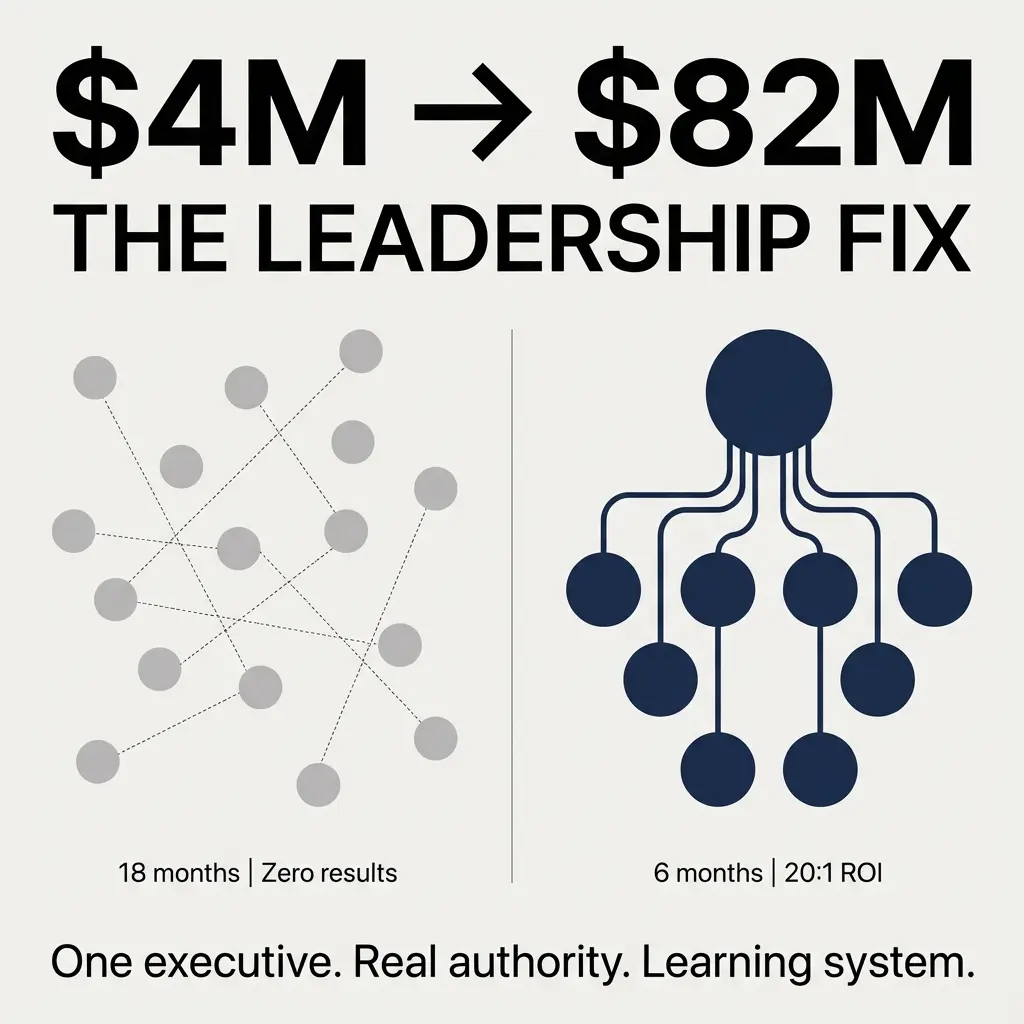
We watched a Fortune 500 manufacturing company burn through $4 million on AI transformation.
Eighteen months. Three consulting firms. Zero measurable results.
The CEO called us in February 2023. His exact words: "We're buying AI tools like they're going out of style, but nothing's changing. What are we missing?"
The answer wasn't more technology. It was Integrated Command and Adaptive Response—Part 3 and 4 of the MPEA framework.
What We Found: A Leadership Vacuum Disguised as a Tech Problem
The diagnostics revealed a familiar pattern. The company had purchased enterprise AI platforms from three major vendors. They'd hired data scientists. They'd run pilots in six departments.
But nobody owned the transformation.
IT thought the business units were driving strategy. Business units thought IT was handling implementation. The C-suite thought both groups had it covered.
This matches the data. MIT research shows 95% of generative AI pilots at Fortune 500 companies fail because of a "learning gap"—organizations don't understand how to use AI tools or design workflows that capture benefits.
More damning: 42% of Fortune 500 executives report AI is "tearing their company apart" because leaders delegate transformation to IT instead of personally driving change.
Building Integrated Command
We started with clear ownership. Not committees. Not cross-functional working groups. One executive with decision authority and budget control.
The company appointed their Chief Digital Officer as AI Transformation Lead. We gave her three things:
- Direct reporting line to the CEO for transformation decisions
- Budget authority to reallocate resources across business units
- Red team program to stress-test every major initiative
The red team concept came from military strategic planning. Post-9/11, the U.S. Army developed red teaming as systematic contrarian thinking—a way to identify blind spots before they become disasters.
We established a rotating red team of senior leaders from finance, operations, and legal. Their job: challenge every AI implementation plan before launch.
The results showed up fast.
In the first red team review, the operations VP identified a critical flaw in the supply chain AI pilot. The team had designed the system to optimize for speed. But the company's competitive advantage was reliability, not speed. The AI would have optimized them right out of their market position.
That single review saved an estimated $800K in wasted implementation costs.
Implementing Adaptive Response
Clear ownership solved the authority problem. But we still needed a learning system.
We implemented After-Action Reviews following every significant milestone. Not slide decks for executives. Active discussions centered on what happened, why it differed from the plan, and what to change next.
Peter Senge notes that AAR efforts fail when "people reduce the living practice to a sterile technique." We avoided that trap by making AARs about learning while doing, not accountability audits.
The manufacturing company ran AARs after:
- Each AI pilot completion
- Every significant integration challenge
- Monthly transformation checkpoint reviews
They posted findings to a searchable database. Action items got assigned with clear deadlines. The CDO reviewed progress weekly.
J.M. Huber Corporation uses this exact approach, posting AAR learnings to a global database and awarding annual recognition for excellence in organizational learning.
The Transformation: What Changed
Six months after implementing Integrated Command and Adaptive Response:
The supply chain AI system went live. It now processes $1.2B in annual throughput with 23% improvement in on-time delivery and 15% reduction in inventory carrying costs.
The quality control AI pilot expanded. From one production line to seven facilities, reducing defect rates by 31% and saving $2.1M annually in rework costs.
The customer service AI deployment succeeded. Handle time dropped 18%, customer satisfaction scores increased 12 points, and the company reduced headcount needs through natural attrition instead of hiring 40 planned positions.
Total measurable return: $82M over 24 months on the original $4M investment.
That's a 20:1 ROI.
What Made the Difference
The technology didn't change. The company still used the same AI platforms they'd purchased 18 months earlier.
Three things created the breakthrough:
Clear ownership with decision authority. One leader who could say yes or no without navigating committee politics. Research shows companies that empower decentralized decision-making achieve up to 30% improvement in operational performance.
Red team challenge before launch. Every initiative got stress-tested by senior leaders with different perspectives. This caught design flaws, misaligned priorities, and implementation risks before they became expensive failures.
After-Action Reviews that created change. The company learned from every deployment, documented those lessons, and applied them to the next initiative. Organizations conducting consistent AARs deliver projects faster, on budget, and with higher ROI.
The Pattern You Can Apply
Your AI transformation probably doesn't need more technology. It needs Part 3 and 4 of MPEA.
Integrated Command means appointing one executive with real authority. Not a steering committee. Not a center of excellence. One person who owns outcomes and has the power to make decisions stick.
Adaptive Response means building a learning system that captures insights and applies them fast. Red teams before launch. After-Action Reviews after completion. Documentation that becomes organizational knowledge instead of PowerPoint archives.
The manufacturing company's CEO told us in December 2024: "We spent 18 months trying to fix a technology problem. You showed us it was a leadership problem. Once we fixed that, everything else fell into place."
That's the lesson.
AI transformation fails because of leadership gaps, not technology gaps. Fix the command structure. Build the learning system. The ROI follows.