


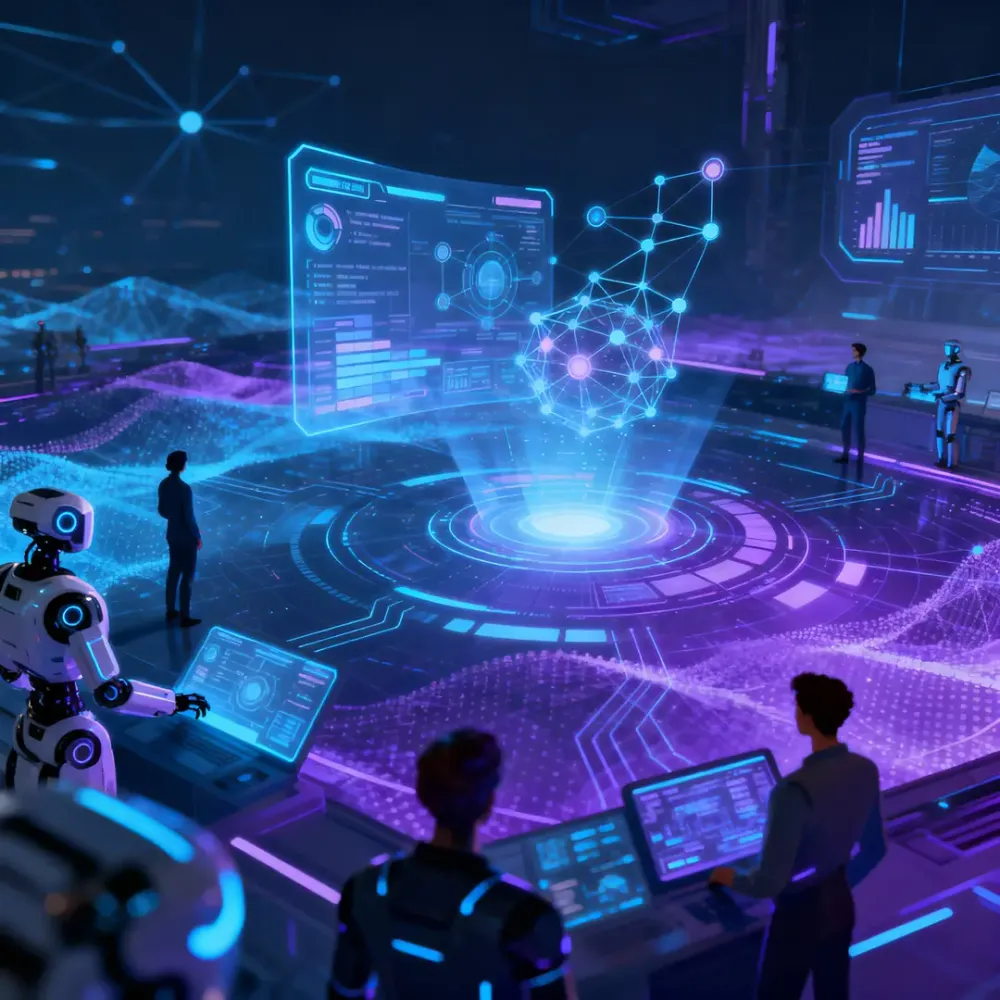
The narrative around automation has fundamentally shifted. A decade ago, enterprise leaders feared robots would replace workers. Today, forward-thinking executives recognize that the real competitive advantage doesn't come from choosing between humans or machines—it comes from orchestrating them together. This is the promise and the practical reality of autonomous systems and human-machine collaboration in 2025, and it's reshaping how organizations think about digital transformation, AI in business, and the future of work technology.
The Collaboration Paradox: Why Humans Plus Machines Outperforms Either Alone
The data tells a compelling story. According to McKinsey's 2025 research, while 92% of organizations plan to increase AI investment, only 1% have achieved full operational integration where AI actively drives measurable outcomes across all functions. This gap reveals something critical: simply deploying AI isn't enough. The organizations winning at digital transformation are those building effective human-machine collaboration frameworks.
Consider what each brings to the table. Humans excel at contextual reasoning, creative problem-solving, ethical judgment, and handling unexpected scenarios. Machines dominate repetitive tasks, process massive datasets at scale, and execute with precision. Together, they're not additive—they're exponential.
Research from MIT AeroAstro and recent IEEE studies demonstrate that when designed thoughtfully, collaborative systems achieve:
- 30-40% productivity gains over human-only or machine-only approaches
- 50% reduction in error rates through complementary strengths
- Improved safety, particularly in hazardous or precision-dependent environments
- Enhanced employee satisfaction through elimination of tedious work
The challenge? Designing systems where this synergy actually emerges. That requires thinking differently about how autonomous systems integrate into enterprise workflows.
The Architecture of Effective Collaboration: From Isolated Automation to True Partnership
Here's what distinguishes mediocre AI implementations from transformative ones: intentional collaboration design. Rather than automating humans out of the loop, the leading enterprises of 2025 are deliberately architecting systems where human and machine capabilities complement each other through structured handoffs and shared decision-making.
The frameworks emerging across industry 5.0 implementations reveal a spectrum of collaborative models:
Human-Led, Machine-Assisted: Humans maintain decision authority while AI provides analysis, recommendations, and data synthesis. This applies across finance, strategy, and executive leadership where contextual judgment remains paramount. AI tools now surface insights executives might miss, freeing leaders to focus on strategic decisions rather than data gathering.
Balanced Collaboration: Humans and autonomous systems share decision responsibility with clear handoffs. Manufacturing environments increasingly deploy this model, where robots perform precision assembly while humans handle quality assessment, problem-solving, and workflow adjustments. Recent implementations in automotive and electronics manufacturing show 20% cycle time reductions with this balanced approach.
Machine-Led with Human Oversight: Autonomous systems handle routine decisions autonomously while humans provide exception handling, ethical guidance, and system governance. This is where agentic AI excels—handling 24/7 customer service, content moderation, or workflow automation while trained teams focus on edge cases and policy decisions.
The critical insight: maturity means knowing which model fits which function. Misalign these, and implementations stall. Get it right, and transformation accelerates.
Enterprise AI Strategy in Practice: Where the ROI Happens
The conversations in C-suites have shifted from "Should we adopt AI?" to "Where should AI live in our business architecture, and what organizational changes must accompany it?"
This strategic reorientation has real financial consequences. According to Microsoft and IDC research, organizations deploying generative AI strategically across their operations are seeing returns of 3.7 times investment, with top-performing leaders achieving $10.3 in ROI per dollar spent. The variance? Execution approach.
Operational efficiency and cost savings represent the fastest wins. Companies deploying AI-powered automation across IT support, expense processing, and routine reporting are reclaiming 2-5 hours per employee daily. Webflow's Flowbot AI assistant handled roughly half of all incoming IT support issues while maintaining a 100% satisfaction rating, illustrating how human-machine collaboration can enhance rather than replace employee experiences. Meanwhile, organizations using intelligent document processing and automated workflows are cutting cycle times from days to minutes.
But here's where enterprise AI strategy becomes sophisticated: sustainable ROI emerges when organizations align AI adoption with broader business process transformation. McKinsey's analysis reveals that organizations breaking down departmental silos and integrating AI across teams—rather than deploying isolated pilots—achieve 2-3x better outcomes. When IT, customer service, HR, finance, and operations coordinate AI deployment, they create compounding efficiency gains and unified data ecosystems that fuel further innovation.
Revenue growth and innovation acceleration follow. Sales teams using AI-powered lead scoring and personalization see improved conversion rates. Marketing departments leveraging GenAI for campaign design and optimization report faster time-to-market. Product teams using AI for rapid prototyping and testing iterate faster. The pattern: when humans focus on strategy and creativity while AI handles execution and optimization, organizational velocity increases measurably.
Technology Leadership in the Autonomous Era: The Chief AI Officer Emerges
A structural shift is underway in corporate leadership. An emerging executive role—the Chief AI Officer—now appears alongside the CIO, CTO, and CMO. This isn't just a rebranding. It reflects a deeper recognition: AI isn't a technology problem to delegate to IT. It's a strategic capability requiring C-suite-level governance, resource prioritization, and transformation leadership.
The CAIO role bridges an organizational gap. Traditional IT leadership optimizes infrastructure. Product leadership drives revenue. But orchestrating AI as a strategic capability requires someone specifically accountable for:
- Enterprise AI strategy alignment: ensuring AI investments ladder to business objectives, not technology trends
- Cross-functional collaboration: connecting isolated AI projects into integrated capability platforms
- Governance and responsible AI: establishing ethical frameworks, bias mitigation, and compliance standards that scale
- Talent and capability building: overseeing the upskilling initiatives that keep organizations competitive as role requirements evolve
This elevation of AI governance reflects a hard-won lesson: AI adoption without organizational alignment delivers pilot-stage results. Strategic AI leadership drives enterprise transformation.
Digital Transformation Redefined: The Cloud-Native, Data-First Foundation
The infrastructure supporting human-machine collaboration looks fundamentally different from traditional enterprise systems. Successful cloud-native architecture and data modernization initiatives enable the real-time data sharing, adaptive autonomy, and collaborative workflows that effective partnerships require.
Cloud innovation has enabled three critical capabilities:
Organizations moving to cloud-native platforms are collapsing data silos, enabling AI systems to access comprehensive information. A financial services firm using cloud-based analytics now identifies risk patterns and fraud across its entire customer base in real-time—tasks a human analyst could never perform alone. The human intelligence? Deciding policy responses and investigating novel risks that pattern recognition flags.
Scalability through cloud architecture: Autonomous systems require infrastructure that scales with demand. Cloud platforms enable organizations to provision computational resources dynamically, supporting peak workload demands without static overinvestment. A logistics company using cloud-based autonomous routing can handle seasonal demand spikes without infrastructure capital investment.
Real-time adaptability: Legacy on-premise systems typically update batch-wise. Cloud-native systems feed real-time data to machine learning models, enabling autonomous systems to adapt their behavior continuously. Manufacturing facilities using cloud-connected robotic systems now retrain models with weekly production data, continuously improving precision and reducing waste.
The organizations struggling with AI adoption often share a common characteristic: siloed, on-premise data architectures that prevent the information flows AI requires. Investment in data mesh strategies—decentralized but governed data architectures—has become a prerequisite for enterprise AI maturity.
The Human Element: Stakeholder Alignment and the Future of Work Technology
Here's where execution often stumbles: technology leaders design elegant systems, but if employees experience them as threatening or confusing, adoption falters.
The research is clear. Studies across manufacturing, IT support, and customer service show that employee concerns about automation cluster around three anxieties: job security, capability requirements, and whether technology will amplify existing workload pressures.
The enterprises succeeding at this tackle these head-on through human-centered AI design:
- Transparent communication about role evolution: Rather than announcing layoffs, leading organizations reframe automation as liberating workers from tedious tasks toward higher-value work. Specific outcomes matter: "This will free you from manual expense processing to focus on strategic vendor relationships" resonates differently than generic automation announcements.
- Upskilling pathways: Organizations committing to retraining displaced workers through concrete learning programs—sometimes offered during work hours—see higher engagement and retained institutional knowledge. The future of work in autonomous-enabled enterprises requires workers who can supervise, interpret, and improve autonomous systems.
- Inclusive design in technology development: Involving end users in designing human-machine interfaces prevents the frustration of poorly conceived systems. Manufacturing plants where workers influence robot configuration see higher adoption and better performance than those where technology is imposed top-down.
The emerging consensus among technology leadership researchers is blunt: organizations that treat automation as a human-centered transformation challenge—not merely a technical deployment—achieve measurable better outcomes.
Building Your Autonomous Systems Strategy: A Roadmap for Enterprise Leaders
For technology executives charting a path forward, several operational principles distinguish effective digital transformation from the pilots that stall:
Start with business objectives, not technology excitement. Before evaluating tools, define the specific business outcomes you're optimizing for—cost reduction, speed, quality, or innovation velocity. This discipline prevents the common trap of deploying sophisticated technology for problems that don't matter strategically.
Identify collaboration opportunities, not just automation targets. Ask where human judgment and machine efficiency could productively combine, not where technology could eliminate human involvement. A manufacturing example: precision welding might fully automate, but quality inspection becomes more valuable when a human uses AI-powered computer vision to catch patterns automated systems miss.
Invest in data infrastructure as foundational. Autonomous systems are only as intelligent as the data fueling them. Organizations that rush to deploy models before addressing data quality, governance, and accessibility usually underperform. Data modernization isn't thrilling like generative AI discussions, but it's prerequisite for sustained AI ROI.
Build governance early, not as an afterthought. Responsible AI isn't separate from implementation—it's embedded in system architecture from day one. This includes bias detection, explainability requirements, and human override capabilities. Organizations waiting to address these after systems are live face expensive retrofitting.
Measure and communicate outcomes relentlessly. The organizations winning at AI adoption quantify results—not just technical metrics like inference speed, but business metrics like cost savings, speed, or employee satisfaction. Regular communication of wins builds organizational momentum and justifies continued investment.
The Convergence Reshaping Industries: Real-World Transformation in Action
The practical impact of mature autonomous systems and human-machine collaboration is visible across sectors:
Manufacturing and Logistics: Collaborative robots, now projected to grow from $1.2 billion in 2023 to $29.8 billion by 2035 at a 34.5% compound annual growth rate, are becoming factory standards. Rather than replacing assembly lines, they're making them flexible. A company can reconfigure cobots for a new product in days rather than months, enabling responsiveness to market shifts. BMW and Ford report 20% cycle time reductions and 15% operational cost cuts through cobot integration.
IT Operations and Support: AI agents now handle Level 1 IT tickets autonomously, but the real transformation emerges when they escalate appropriately to human specialists. Organizations achieve 50% reduction in support backlogs while improving resolution satisfaction—the machine handles volume; humans handle complexity.
Financial Services and Risk Management: AI systems now analyze transaction patterns across millions of data points in real-time, flagging fraud or risk faster than any human could. But humans make policy decisions and investigate novel threats that algorithmic patterns don't recognize. The collaboration is seamless when each plays its role.
Healthcare: AI systems assist in diagnostic imaging analysis and clinical trial design, but physicians remain essential for contextual judgment, patient communication, and treatment decisions requiring ethical consideration. Systems that position AI as physician replacement stall; those positioning it as diagnostic capability accelerator scale.
The Path Forward: Why This Moment Matters for Digital Leaders
We're at an inflection point. The technology is real, the business case is proven, and the organizational models are emerging. But transformation doesn't happen automatically. It requires leadership commitment, sustained investment, and honest reckoning with how technology reshapes work.
The executives succeeding in this transition share a common characteristic: they see autonomous systems and human-machine collaboration not as threats to organizational stability but as levers for competitive advantage. They're investing in cloud-native architecture that enables real-time collaboration. They're building enterprise AI strategy that aligns technology with business outcomes. They're treating stakeholder alignment as central to transformation, not peripheral.
And crucially, they're measuring ROI. The data demonstrates that organizations executing deliberately see sustained returns—3.7x investment in the near term, with compound gains as capabilities mature.
The organizations that will lead through 2026 and beyond won't be those with the most sophisticated AI. They'll be those that architected the most thoughtful human-machine partnerships. That's not a technical challenge—it's a leadership challenge. And it's the challenge defining digital transformation in 2025.
Conclusion
Autonomous systems paired with intentional human-machine collaboration represent the most significant shift in enterprise productivity architecture since cloud computing. The financial opportunity is substantial—organizations executing strategically are seeing 3.7x returns on AI investment. But the real value extends beyond ROI: it's organizations becoming more responsive, more innovative, and ultimately more human-centric.
The technology works. The business case is proven. The competitive advantage now belongs to those who navigate the organizational transformation skillfully. For digital leaders committed to building future-ready enterprises, the path forward involves rethinking automation as collaboration, investing in foundational capabilities, and leading your organization through this transition with clarity and purpose.
What's your organization's readiness for autonomous systems integration? Share your thoughts, challenges, or success stories in the comments below.